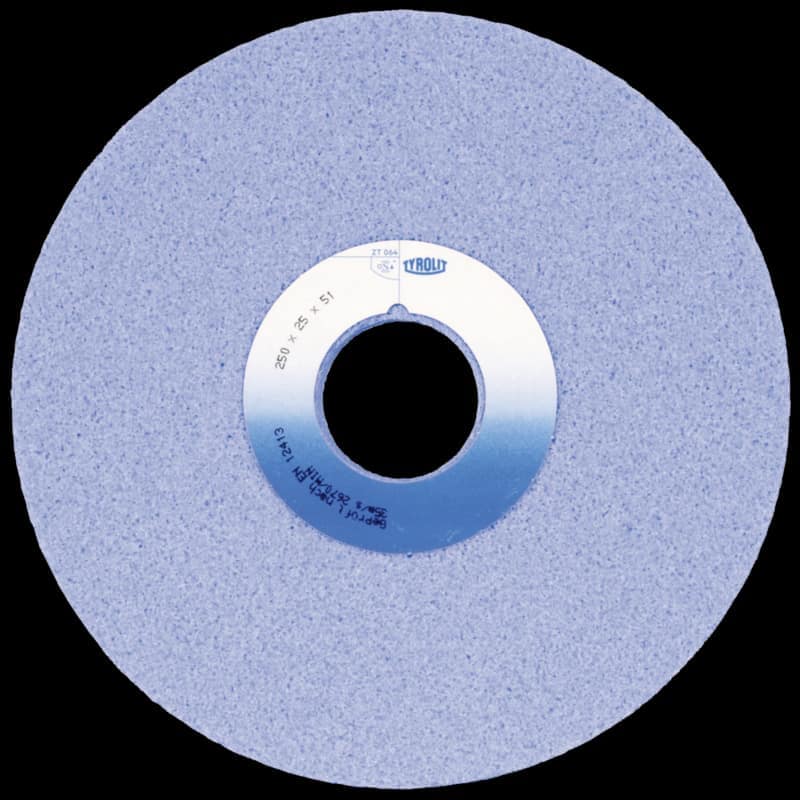
Tyrolit
Tyrolit Floor Grinding & Polishing Pads | Diamond Resin & Metal Bond Pads for Floor Grinders
Tyrolit Grinding and Polishing Pads are the core consumables for achieving a flat, refined, and high-gloss polished concrete floor using planetary and rotary floor grinders. Unlike generic pads that may offer only polishing steps, Tyrolit’s range spans the complete floor transformation: metal-bond diamond pads for initial floor flattening and aggressive stock removal, transitional hybrid pads to bridge the coarse-to-fine scratch transition, and premium resin-bond diamond polishing pads to deliver the final light-reflective mirror finish. The pads are produced in standard 80mm (3”) and 100 mm (4”) button sizes that mount onto quick-change backing plates on all common floor grinders, as well as larger 170 mm–200 mm (7”–8”) pads for swing machines. Tyrolit’s diamond dispersion technology and engineered bond hardness ensure two key outcomes: rapid cut rates that reduce machine hours on site, and complete scratch removal at each grit stage, eliminating the “cobweb” or swirl marks that plague inferior pads. Additionally, specialized pads exist for very hard concrete, very soft concrete, terrazzo, and natural stone, ensuring the right tool is available for every slab condition. Contractors appreciate Tyrolit’s structured grit progression charts and on-site support, which turn a complex polishing process into a repeatable, profitable service.
Send an Enquiry
We'll get back to you on WhatsApp.
Trusted by Industry Leaders
























Complete Grit Progression from Flattening to Glass Finish
A full spectrum of metal bond (16–120 grit), transitional (50–200 grit), and resin pads (50–3000 grit) ensures systematic scratch refinement and predictable high-gloss results.
Rapid Cut Metal Bond Pads for Leveling
Aggressive diamond matrices remove high spots, lippage, and thin coatings quickly, reducing the time a heavy planetary grinder runs on coarse grit—saving fuel, electricity, and operator hours.
Zero-Scratch Transitional Pads for Process Efficiency
Engineered to remove metal bond scratches faster than jumping straight to resin, transitional pads slash the number of polishing steps required, allowing more square meters finished per shift.
Material-Specific Bonds for Hard and Soft Concrete
Tyrolit offers pad lines optimized for extremely hard (quartzite, river rock) aggregate that resists diamond penetration, and soft, sandy concrete that erodes standard bonds too quickly.
Swirl-Free Polishing Technology
Advanced resin formulation and diamond size control prevent the “halo” or swirl marks that require re-polishing, achieving DOI (Distinctness of Image) values specified by architects and retail brands.
System Integration with Tyrolit Floor Grinders
Pads are tested for optimal weight, speed, and water flow parameters on Tyrolit machines, eliminating trial-and-error set-up and ensuring first-time-right polishing quality.
Why Tyrolit’s 3-Step Grinding-Polishing System Outperforms 5-Step Generic Approaches
Lower-quality polishing pads often require more grit steps to remove scratches, because the abrasive sizing is inconsistent or the bond does not break down properly, leading to rogue deep scratches surviving into the polishing stages. Tyrolit’s tightly controlled diamond particle sizing and bond degradation profiles allow a condensed, more efficient step sequence. For example, a typical Tyrolit process for a cream-polished concrete floor might be: Step 1 – 30/40 grit metal bond to flatten; Step 2 – 50/100 transitional resin to remove metal scratches and begin surface closure; Step 3 – 200 to 3000 resin polishing. The elimination of two machine passes per square meter directly saves labor and fuel, making the contractor more competitive on daily rate projects. Additionally, Tyrolit pads are manufactured with consistent thickness, ensuring that all pads contact the floor uniformly, preventing the uneven wear patterns that cause “smiley face” marks or patchy gloss.
Selecting the Right Tyrolit Pad for Your Concrete Slab and Finish Target
Concrete is not uniform. Aggregate hardness (Mohs scale), cement paste softness, and slab age all affect diamond pad performance. Tyrolit application engineers classify projects by slab condition: soft concrete requires a harder bond to resist rapid erosion; hard concrete requires a softer bond to expose fresh diamond continuously. The desired finish level—satin, semi-gloss, or high-gloss—determines the final polishing grit. For decorative aggregate exposure (salt-and-pepper or full aggregate), specific metal bond pads with larger diamond grits are used in early stages to open the slab. Tyrolit provides easy-to-use selection charts and, for large projects, sample pad kits for on-site testing to confirm the optimal specification before full production begins.